Carolina Fox Pest ControlCarolina Fox Pest Control

Structural Wood-Destroying Beetle Remediation Raleigh

Wood-destroying beetles colonize damp substructural timbers, where larvae excavate galleries inside pine joists, sill plates, and oak support beams for 1 to 10 years before emerging as adults. In historic neighborhoods…
Get My Free Estimate →(984) 742-7042
Structural Wood-Destroying Beetle Remediation in Raleigh, NC
Quick answer
  • What is included: Subfloor sounding, wood moisture mapping, localized deep-penetration borate application, and structural frass removal.
  • Response time: On-site structural inspections are scheduled within 24 to 48 hours across Wake County.
  • Cost range: Comprehensive localized remedial treatments range from $500 to $2,500; the absolute minimum service call charge is $250.
  • Target pests treated: True powderpost beetles (Lyctinae), deathwatch beetles (Anobiidae), false powderpost beetles (Bostrichidae), and old house borers (Hylotrupes bajulus).
  • How to schedule: Request an on-site structural moisture and timber inspection by calling (984) 742-7042.

Wood-destroying beetles colonize damp substructural timbers, where larvae excavate galleries inside pine joists, sill plates, and oak support beams for 1 to 10 years before emerging as adults. In historic neighborhoods such as Oakwood, Boylan Heights, and Mordecai, early 20th-century heartpine and mixed hardwoods frequently harbor Anobiid powderpost beetles sustained by unsealed crawlspace vents and damp crawlspace soil. Newer tract framing in Wakefield and Brier Creek more commonly exhibits old house borer emergence holes in kiln-dried framing lumber where elevated humidity has rehydrated structural softwoods. Structural remediation differs from cosmetic spraying: liquid borate salts penetrate 1/2 inch to 2 inches into exposed wood fibers to poison larvae as they chew, while exterior soil barrier treatments target ground-swarming subterranean pests like termites without curing beetle activity inside the wood.

Remediation feasibility is dictated by wood moisture content and timber accessibility. Borate diffusion remediation fits crawlspaces where structural joists register above 12% moisture content, allowing the glycol or water carrier to transport disodium octaborate tetrahydrate deep into the timber grain. If joists are fully enclosed behind drywall or spray-foam insulation, mechanical injection or timber replacement is required because topical diffusion cannot bridge synthetic vapor barriers. The operational trade-off centers on moisture management: applying chemical borates without correcting crawlspace humidity below the 18% larval survival threshold allows re-infestation over time, whereas moisture control paired with targeted timber saturations halts active wood loss permanently.

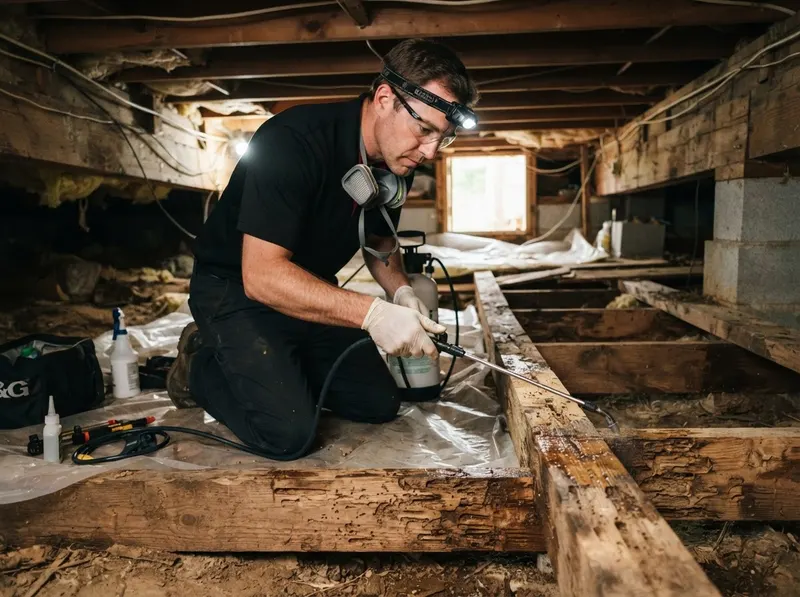
Technicians deploy a four-step remediation protocol across affected Wake County properties:

1. Surface timber sounding and pin-probe moisture metering across all perimeter sill plates and primary support girders.

2. Removal of heavy surface frass, fungal growth, and dirt dauber deposits using mechanical HEPA brushes to expose bare wood grain.

3. Direct low-pressure application of disodium octaborate tetrahydrate at 15 to 25 psi until structural framing reaches liquid refusal.

4. Placement of crawlspace monitoring traps to audit emerging adult beetles over the subsequent flight seasons.

Structural Wood-Destroying Beetle Remediation cost in Raleigh

Minimum Service & Diagnostic Sounding$250
Localized Joist Band & Sill Plate Remediation$500 - $950
Full Substructure Crawlspace Timber Borate Treatment (1,000 - 2,000 sq ft)$1,200 - $2,500
Extensive Pier, Girder & Joist Timber Remediation (Over 2,000 sq ft)$2,500 - $4,800

Every job gets a firm, written price after a free on-site visit.

Common questions

How can homeowners in Raleigh identify structural wood-destroying beetle damage?
Homeowners identify wood-destroying beetle damage by finding 1/16-inch to 1/8-inch round exit holes accompanied by piles of fine, talcum-like wood powder called frass beneath floor joists and sill plates.
What is the difference between powderpost beetle damage and subterranean termite damage in Raleigh homes?
Powderpost beetles pack structural galleries tightly with fine wood flour or granular pellets and leave distinct circular emergence holes on the surface, whereas subterranean termites pack galleries with damp mud tubes and hollow out wood along the grain.
Does structural beetle remediation in Raleigh require tent fumigation?
Structural beetle remediation in Raleigh rarely requires whole-structure tent fumigation, as localized penetrative borate salt applications to exposed crawlspace joists and sill plates resolve typical Wake County infestations without displacing occupants.
Why does crawlspace humidity accelerate wood-boring beetle infestations in Raleigh properties?
Crawlspace humidity accelerates wood-boring beetle infestations because beetle larvae require wood moisture levels of 13% to 20% to digest wood starches and complete their multi-year development cycles.
Are the chemicals used for wood-destroying beetle remediation safe for household pets in Raleigh?
Disodium octaborate tetrahydrate solutions used inside crawlspaces bind directly to structural wood fibers, presenting minimal risk to household pets once dry because the material remains contained beneath the living quarters.

Get started today

Tell us about your structural wood-destroying beetle remediation job in Raleigh and we'll send a clear, written quote, usually the same day.

Get your free Pest Control Service quote, Raleigh

We only use your ZIP to check availability, no spam.