Crawlspace rodent exclusion targets the biological vulnerabilities of Wake County foundations. In historic neighborhoods such as Oakwood, Boylan Heights, and Mordecai, early-to-mid-20th-century brick piers and clay…
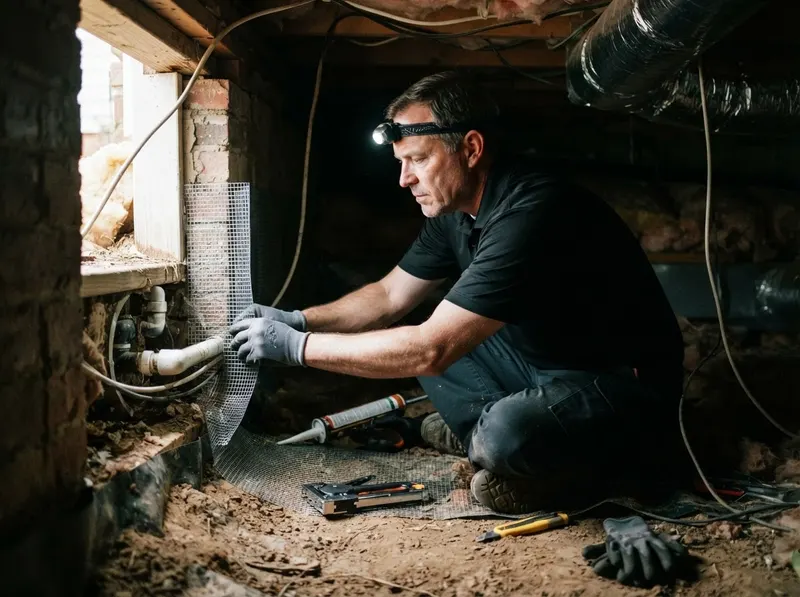
Crawlspace rodent exclusion targets the biological vulnerabilities of Wake County foundations. In historic neighborhoods such as Oakwood, Boylan Heights, and Mordecai, early-to-mid-20th-century brick piers and clay foundation vents develop structural settling cracks wider than 1/4 inch, permitting juvenile mice and Norway rats to access floor subassemblies. Modern crawlspaces in North Hills, Five Points, and Glenwood South frequently feature unsealed HVAC line sets and plumbing penetrations that run directly through concrete footings. Surface-level pest spraying or continuous placement of poison bait blocks fails to solve these intrusions because exterior rodent pressure from nearby wooded basins, such as William B. Umstead State Park or Lake Johnson Park, quickly replaces poisoned populations. Mechanical exclusion stops ingress permanently by denying physical entry.
Selecting crawlspace exclusion over ongoing bait station programs requires evaluating long-term structural integrity against upfront installation costs. If a homeowner deploys bait blocks alone, dying rodents frequently expire inside subfloor insulation or HVAC flex ducts, generating persistent decomposition odors and secondary carpet beetle infestations. Mechanical exclusion requires an upfront investment, but it secures the building envelope permanently without introducing anticoagulant compounds that pose risks to domestic pets or non-target predatory wildlife. The technical standard demands 19-gauge hot-dipped galvanized hardware cloth with a 1/4-inch grid size, as standard wire insect screening or expanding polyurethane foam can be chewed through by an adult Norway rat in less than 48 hours.
Execution follows an objective sequence across the foundation perimeter. 1. Technicians inspect the exterior curtain wall, checking grade lines, foundation vent louvers, sill plates, and crawlspace access well doors. 2. Penetrations around gas pipes, drain lines, and electrical conduits are reinforced using pre-cut steel plates and copper wire mesh bonded with non-hardening elastomeric sealants. 3. Foundation vents receive custom-fitted exterior hardware cloth panels mechanically anchored into brick, cinder block, or stone with concrete tapcon screws. 4. Interior snap traps are positioned along foundation sill ledges to extract any rodents trapped inside the envelope during exclusion, with removal scheduled 7 to 10 days later. High-moisture red clay soil across Wake County accelerates wire rust, making zinc-coated galvanized hardware mandatory for long-term defensive integrity.
Every job gets a firm, written price after a free on-site visit.
Tell us about your crawlspace rodent exclusion and defense job in Raleigh and we'll send a clear, written quote, usually the same day.
 Carolina Fox Pest Control